Movies seen in 2026
(Work in progress, as the year progresses, so remember to check every now and then if anything new popped up in the meantime.)
Beware: There are a couple of spoilers ahead, as those are predominantly notes for myself. Nothing all too serious, but one or two twists are revealed.
Cutthroat Island
The first movie to finish this year (but not start) was 1995's "Cutthroat Island," the infamous record holder of the biggest box-office bomb. It's a very classic pirate movie, plot-wise, although the closer we get to the end, the more boring it becomes. That being said, there are motifs that looked like re-used in "Pirates of the Caribbean" movies later, so it's curious that this movie was such a failure. Music brings back the old Star Wars.
As a side note, I recognised that Jamaica's Port Royale was shot in Malta, namely in St. Elmo Fort, which was used for a Turkish prison in "Midnight Express." As I am a fan of "Midnight Express," I visited the aforementioned fort many times during my living there; though, I never got to that part. But here, there's more: they also use the streets and the shore in Valletta, where we used to walk many times. And that was a weird part, which was breaking the immersion for me a little. Not that it's anyone's fault, but still, I could clearly see that it's not Jamaica. Similarly to the later part, which was shot in Thailand; and while I was not there, I saw those mountainy islands in "White Lotus 3."
Snake Eyes
"Snake Eyes" (1998) is a thriller about a cop who unexpectedly ends up running an ad-hoc investigation, when a murder happens during a boxing gala. It got old very well, with all the then-growing surveillance technology and cameras everywhere, which are pretty normal now. There is also a number of mastershots here, which are always welcomed. And the plot is more about why, not who, which was criticised at the time but tastes better years later. Also, I did not expect to see young Carla Gugino.
Roma
Federico Fellini's "Roma" (1972) is, on paper, a semi-autobiographical movie, but it feels more like a set of vignettes. Luckily for both of us, I like vignettes. The autobiographical part is rather implied, and the whole movie is a love postcard to the city of Rome. It feels more like a documentary on old times and a vibrant Italian culture (those Italian suppers). We agreed with my wife that if we didn't live in the South of Europe, we would think it's more of a metaphor. But no, it's how it is.
Eden
Ron Howard's "Eden" from 2024, based on true events, is a story of 8 people who inhabited the island of Floreana in Galápagos Archipelago. As an aficionado of islands, I really liked the setting. It's a pretty well painted picture of why living on a remote island is not the paradise that people like to think it would be. Good casting, but the main award goes to Ana De Armas as a phony baroness who sows a dissent among all the islanders.
After the movie, I went to Wikipedia to read a bit more on the location, and I found it somewhat amusing that this happened on an island of size of 173 km². After living for almost 3 years on Malta, which size is 330 km² (although the main island itself is around 250 km²), I can clearly imagine all the 3 groups of people living in such a distance that they wouldn't have to see each other. And yet. But it's probably the baroness' fault.
Another interesting fact is that in 1800s the island burned down, due to a prank gone wrong; a prank that was pulled by a sailor from "Essex," or fully, "Essex of Nantucket," the ship which was attacked and sunk by a whale; all which was depicted in "In the Heart of the Sea," which I have seen last year. And which inspired "Moby Dick." It all connects nicely.
Eddington
"Eddington" (2025) is a story of a small-town sheriff who, in the midst of COVID-19 pandemics, decides to run for the mayor. At first, it seemed that was going to be the plot, but as the movie progressed, it began expanding its scope, mixing a lot of stuff in (like conspiracy theories and Antifa, albeit with artistic licence). Overall, it was interesting because it was not possible to predict what will happen next.
Spoiler: The idea started as a western, something like a decade ago, and was covidified only recently. Lockdowns made the empty town plausible. The final shooting with Antifa goons plays out like a video game, especially taking the heavy gun that the sheriff brought (it tore off half of a leg of one person).
The plot was a lot, but was still more manageable to follow than the one from "Beau Is Afraid" from the same director. Due to epicness and a lot of things going on, it reminded me of "One Battle After Another," and perhaps, that's a new direction of movies. Less three-act arcs, and more dynamic stories that can even shift its focus halfway through. Now, I know this is probably not for everyone, but we are getting it, so I'm not gonna complain.
And honestly, I prefer "Beau Is Afraid" and "Eddington" to "Hereditary" and "Midsummer," director's earlier movies, which were straight horrors that disappointed me with their endings. Like, no, thanks, we had enough of those.
Nomadland
"Nomadland" (2020) depicts a live of Fern, a Usonian nomad: she's moving in her van, adjusted to living, through the U.S., and catching seasonal jobs, from Amazon during the Christmas frenzy, to beet root plant. The movie feels like a half-documentary, and for a good reason: nomads that Fern meets in her journey are real people playing themselves. It starts with a premise of a downer, but ends up to be a very heartwarming and touching story. Plus marvellous landscapes.
The movie reminded me predominantly of two things: the first are Wim Wenders' "Perfect Days," due to showing a sort of solace in every day's rhythm and routine; and the second is generally Werner Herzog movies, due to using naturals as actors; albeit, it mildly brings fond memories of "Stroszek," however without the horrible ending.
Sinners
I didn't know what was the story behind "Sinners" (2025), so it surprised me a bit when vampires showed up; and this was after I joked that it starts like "Lovecraft Country." Similarly to there, there is strong historical background presented. Moving forward, however, the movie started resembling "From Dusk Till Down," which is not a bad thing, as some sort of homage was maybe overdue. There is a lot of singing, bordering the movie on musical, but somehow, they made it work.
That being said, it was our plan B, after the selection for the evening had trouble with sound (those smart TVs do get dumbfounded by various compression methods, I reckon), and I don't think I would go for it on my own. As horror, it doesn't really work; I would categorise it more as supernatural action movie.
But the vampire leader was pretty interesting, by how deceptively affable he was.
The Hidden
"The Hidden" (1987) is a glorious, shameless sci-fi action horror. Kyle MacLachlan plays here an aloof FBI agent, pre-Twin-Peaks, and it's a perfect casting. He brings all his Kyleness to the role, which initially helps to fool us, the viewers. Something that would be a twist and major reveal in other movies happens almost immediately, thus making us guessing when the detective on the case will catch up with that. Fantastic 80s rock completes the picture.
There is a sequel, but it's a direct-to-video follow-up done by a completely different crew, so I'll skip it.
Alice in Wonderland
"Alice in Wonderland" (2010) is Tim Burton's take on the classical classic, and he does it with some changes: Alice has a different last name (although, I don't remember if she had one in the book) and is older, and in the movie she returns to Underland (that she calls Wonderland), but she doesn't remember that; a bit like "Hook." Characters are expanded and there is more linear plot and standard good-versus-bad story, which I'm not sure I like. But visually it holds.
The House with Laughing Windows
"The House with Laughing Windows", 1976, is a giallo horror, but it's not very scary by today's standards. Probably the most scary part is when the main character is kicked out of his hotel and has to move to an old mansion, which checks all the boxes in the haunted-or-at-least-creepy-house form, which he does as if it was nothing; then he wanders to the attic. Apart from that, it's a slow-paced mystery about a weird village with a dark secret. Not bad, but only for connoisseurs of the genre.
Alice Through the Looking Glass
"Alice Through the Looking Glass" (2016) is a follow-up to "Alice in Wonderland," but it deviates even further from the source material; not that it's bad: with Tim Burton gone, the story takes more standard approach, and in the end, I liked it better, even if it's a sort of a low ball in the creativity department. Sacha Baron Cohen is excellent as Time, complete with his Werner Herzog accent. Luckily, there were no more books, so we can call it a day.
Henry: Portrait of a Serial Killer
"Henry: Portrait of a Serial Killer" is a 1986's cult classic, which I was planning to see for years but kept forgetting. Now I remembered. It's very bleak, both thematically and visually, but it aged like fine wine. Due to budgetary constraints, most of the murders are shown as a detailed aftermath, with voice over of the murder. At the same time, scenes between Henry and Otis look like taken out of a sitcom. It could easily be an entry in the "Monster" anthology.
The drone music, combined with slow pacing, reminded me heavily of "Too Old To Die Young," which I am currently rewatching. This further shows that the movie was ahead of its time. And due to problems with rating and finding distribution, it was not until 1990 that many people could see it.
The director made a documentary before "Henry," and was gonna make another one, but the project collapsed. However, they had money in place, so they did this horror instead. Hence, I think, still docu vibes.
Knox Goes Away
"Knox Goes Away" is 2023's Michael Keaton's, both directed and starred, movie about a contract killer who discovers is being devoured by dementia and has literally a couple of weeks left. The movie feels like a long-overdue spiritual successor to "Memento," with Knox writing things down, and slowly losing it. There is a whole noir layer in the movie, but it felt more like a pretext to show dealing with own's impeding death. And it's funny at the same time.
State of Grace
"State of Grace" (1990) is a gangster movie telling a story of an Irish gang in New York's Hell's Kitchen; it's loosely based on an actual gang of the Westies. A lot of now very well-known actors (maybe even then): Sean Penn, Ed Harris, Gary Oldman, Robin Wright, or John Turturro. It's not bad, but as of 2026, it's sort of mediocre. I have to agree with Roger Ebert on this one: it starts quite originally, but we end up with same old, same old. It's still a solid piece of cinema, though.
Hot Shots!
I saw "Hot Shots!" when I was young, and I don't really remember if it was very funny. I do remember quoting stuff with my classmates, but I can't recall the extent to which it was amusing me. Now, years later, it rather has funny moments at best. Overall, it's so and so. The funniest I found was the manner in which Charlie Sheen and Valeria Golino talk, as if they were parodying something but it was forgotten what.
The character of the general, played by Lloyd Bridges, reminds me of the nowadays Donald Trump, who wanders off the topic and has aloof monologues about, well, hard to say about what.
It was also interesting to see Kevin Dunn from "Veep" in a younger role. He was also in "Snake Eyes," which is an example of retro recognition, when you see an actor and then they're in all the other movies, all of a sudden.
Brussels by Night
"Brussels by Night" is a Belgian movie from 1983. The story starts with a man who tries to commit a suicide in the very first scene, but decides not to, and instead, he leaves his house and starts wandering the streets. On his way, he meets an old acquaintance, then a bartendress and a Moroccan from a bar. There's a sense that he tries to achieve something on the way, but doesn't know himself what. I liked the bleak colours of December and 80ish music. I wasn't happy with the finale, though.
A spoiler revealing another movie with the same twist: The movie reminded me of Swedish "The Ape," where the main character was wandering more or less aimlessly, too, and at some point, I started suspecting there is the same explanation in both movies. And I was right. I understand that "Brussels by Night" is an early example of this, so I cannot really complain, nor accuse the movie of anything, but I would like to see a movie with a lighter reason to wander here and there.
"Brussels by Night" reminded me in the beginning of Jim Jarmusch's "Limits of Control." But then it spiraled into its dark backstory. I still recommend it, as it's a solid piece of cinema. And because it was shot in real scenery, it documents a world which is forever gone.
The Forgiven
"The Forgiven" is a story of a marriage that, driving to a party in a middle of Moroccan desert, hits and kills a young boy, which starts a chain of reaction. I was so afraid that it's gotta be a silly, Columbo-flavoured plot, but nothing of such: it's actually very well research and interesting journey of a man, intertwined with his rich (other) rich friends who party like there's no tomorrow. It reminded me a bit of "White Lotus." And Morocco is beautiful and shown quite decently.
Nope
"Nope" is a movie whose trailer I must have seen when it was released, and it caught my attention because I was not able to figure out what the plot is about; far too many movies these days have trailers explaining the plot ahead, I guess to attract more people, but it doesn't work for me. It's a science-fiction movie, with subtle touches of horror, and it tells a story of a young horse rancher who discovers that something's not right. Something not right being UFO.
A lot of times, movies try to explain things; and to do that, they have to make up a lot of stuff, so we end up with elaborate alien dynasties, which are thinly-veiled human stories. Which is fine, I guess, if you're using aliens as an aesthetics. But not here. It's closer to Stanisław Lem's "Solaris," where they first had to understand what they're up against, and it was not human, so it didn't share our mental models. In other words, the alien here is alien, not a humanoid speaking English.
The later part reminded me of "Jaws," in a similar manner to "Jeepers Creepers 2." And at some point, I had suspicion that it might have similarities to the plot of "Under the Skin" with Scarlett Johansson (but you need to see it to see if I was on track with this one). I also liked the main character, OJ, who was very methodic; autistically even, we could say. Other characters were solid too. And the subplot with monkey! Really strong writing here.
I don't need to add that I was hyped to learn that a sequel might be on the way.
Lady Snowblood
"Lady Snowblood" from 1973 is a Japanese gory movie about a young woman seeking a revenge for what was done to her family. The film is known to inspire "Kill Bill," with The Bride's storyline and all. I was surprised when Meiko Kaji's song, which I knew from "Kill Bill, Vol. 1," started playing at the beginning. And then it turned out that Meiko Kaji is the actress. It's very bloody, and, similarly to Tarantino's movies, told out of order. As such, it got old extremely well. Kudos.
T2 Trainspotting
I recall that when "T2 Trainspotting" came out in 2017, the general opinion was that it was so-and-so, therefore, I skipped it. But now Netflix served it to me on a plate, so I decided to give it a shot, after all. And once again, I am proven that I should not listen to the general public, for they know shit. The movie's okay, telling a story of Mark, who visits old friends and catches up with them. I suppose it's not as breakthrough as the first movie, but I was never captured by it as much as people around me.
It could be that I have seen the first movie in my 20s, and this one now when I'm at age close to the characters again, and it just found the right moment. Timing is everything. I liked the music and how stuff that felt random turned out to be a Chekhov's gun. Always welcomed.
Peaky Blinders: The Immortal Man
"Peaky Blinders: The Immortal Man," 2026, is a movie set in the same universe as the show; and with action set 6 years later, it acts as a distant finale. Some characters are gone by now, the rest moved on. I liked the plot with Nazis intending to flood Great Britain with counterfeit money, but generally, this movie was unnecessary and doesn't really contribute much. That being said, Barry Keoghan as Duke Shelby was a nice addition to the crew. And excellent music, well composed into the scenes.
The movie follows in steps of "Luther," which was also taken over by Netflix and had a movie afterwards. Though, "Luther: The Fallen Sun" looked like open for continuation, which I just confirmed, whereas for Peaky Blinders, it's probably the end of the road.
One day later...
Apparently not. Alas, there will be another actor to play Duke Shelby.
Orlando
And now, for something completely weirder -- "Orlando" (1992), an adaptation of Virginia Woolf's book. A story of a man who lives for 400 years and turns into a woman at some point. Due to his/her age, they meet many historical people on the way. I liked the scenes in the Middle East, which were shot in Azerbaijan; there is something appealing about their raw architecture. The movie was getting weirder with each minute, and I liked that, not being able to guess where it's heading.
Naked Gun
"The Naked Gun: From the Files of Police Squad!" which I always thought to be titled simply "Naked Gun," is a 1988's comedy about Frank Drebin, a goofy policeman and his goofiest adventures. It might be known more for its most recent new movie. I've seen "Naked Gun" many times before, so I was curious how it holds, and -- similarly to "Hot Shots!" -- it's not as funny as it used to be, though funnier than "Hot Shots!" I like how everything funny is overdone at least twice.
The Void
"The Void" is a cosmic horror from 2016. The plot follows a small-town sheriff who finds a beaten-up man emerging from the forest; he then takes the man to a hospital, where things begin to get weirder and weirder. It was the last cosmic horror that I had on my watchlist, though I am not sure if it's so cosmic. Visually well thought out, but there was something off all the time. I think I have to agree with the "paper-thin plot" criticism that some reviewers brought up.
I had problems with guessing what could be happening next, despite the movie being a pretty standard horror, because it doesn't explain almost anything. On paper, it should be good, the "show, not tell" principle, but practically, it's closer to a patchwork of various horror tropes and concepts put together; and while this, on the other hand, makes it sound bad, the creators actually pulled that part off quite nicely. A really mixed beast, this one.
Spoilers: I was lost as to who were the two guys from the beginning, but we put it together with my wife afterwards. Then, it's not really explained who the cultist in white robes are, as they're more of decoration. What cosmic powers the doctor serves is completely not named, which is probably a good thing, because those explanations are usually lame, anyway. So, after the movie, it all makes sense, more or less, but not when you're watching it.
Further spoilers: The monster initially reminded me the alien from "The Hidden," but it quickly evolves into this pile of organs, which brought back fond memories of the final segment of "The Substance," but later monsters looked more like coming from Clive Barker, and I don't mean as much "Hellraiser" as rather the Tortured Souls toyline. So, then, throw the hospital sequence from "The Jacob's Ladder" into the mix. Some said it's in David Cronenberg style, but to me, it feels accidental.
The big bad spoiler: The final form of the doctor, who turns out to be the mastermind behind the whole thing, looks exactly like Vecna from "Stranger Things," season 4, and even has the same voice, which made us suspect that maybe there was an inspiration here.
And then that pyramid at the end, what the hell was that? Perhaps, feeling lost is the part that makes it a cosmic horror.
To summarise, it's a position rather for horror buffs only, as it recycles various elements so well that you don't really think how minimal the plot is. Then, it's well done horror, with practical special effects, and some sort of dread looming over everything. The hospital setting made me think mostly of "Halloween II" (1981). There was potential for more, but we can't always have nice things.
Kokuho
"Kokuho" is a Japanese epic movie, telling a story of an onnagata, an actor playing female roles in kabuki theatre. And when I say epic, I mean the volume of it: the action spans 50 years and has many twists on the way. It was very well researched and prepared (the main actors spend 18 months with an actual theatre). For all the Japan lovers, it's a must. It's also very educational. Just wow.
Strange Darling
"Strange Darling" is a thriller that starts with a woman running away from someone. But I don't wanna say too much. The plot is told out of order and offers a lot of twists; way more than there would be chronologically. Thanks to the selection of songs, the movie reminded me of Quentin Tarantino's style and a bit of "The End of the F***ing World." Shot on 35mm camera (by Giovanni Ribisi), it's a strong homage to the 1970s, but as if filtered through the 1990s, so the second order of abstraction.
The Surfer
"The Surfer" (2024) is a psychological thriller with Nicholas Cage. A man comes to a beach to show his son a place where he wants to buy a house, but gets stranded there due to a local gang of surfers. For the most time, the movie plays out like a nightmare that you can't wake up from, very much like the opening sequence of "Beau Is Afraid." Somewhere in the middle, I figured out how it will end. But it's a solid stuff. It felt weird because the beach and its parking reminded me of Għajn Tuffieħa, where I spent a lot of time when I lived in Malta.
Jules
"Jules" (2023) is a story of Milton, an elderly man slowly sliding into dementia. Early on, a flying saucer lands in his garden, but nobody believes him because he's old, so he starts helping the alien out. Then two of his friends join the party. Advertised as a comedy, which it is to a degree, it's rather a touching story of getting old. It was like "Knox Goes Away" but without crime aspect. Also, Ben Kingsley with long hair looks like Larry David.
The whole time, the movie felt like one of the 1990s Disney productions, or a Hallmark movie. There was this aura of friendliness and non-violence, and even police or secret service agents were more of a natural consequence, but they didn't do much in the end. But! While it might sound like a bad thing, "Jules" pulled that out successfully.
Exotica
"Exotica" (1994) is definitely a weird one, but in a good way. It's a rather ensemble cast, as the plot follows a couple of characters: a man obsessed with an erotic dancer, a DJ there, as well as the owner, then an owner of a pet shop. During the film, it all seemed coming from nowhere, but once it finished, all the pieces made sense. It was really good to see Don McKellar; I really like him. And young Bruce Greenwood; well, youngish -- that I didn't have on my bingo card.
The movie was advertised in the U.S. as an erotic thriller, but it's neither erotic, despite action set in a strip club, nor thriller. If anything, it's a drama.
The Captive
"The Captive" is a story of 5 years that Miguel de Cervantes, the creator of Don Quixote, spent in Algerian prison. It's not strictly biographic, as it heavily leans on Cervantes' gaiety, but it doesn't matter: it's a good story of someone who learns the power of telling stories. And visually, it's really well done. I liked how they threaded in Don Quixote and Sancho Panza. While it was shot in Spain, not Algiers, we have a lot of Muslim castles here to make it work.
Sliver
"Sliver" is an erotic thriller from 1993, starring Sharon Stone, William Baldwin, and Tom Berenger. As all the erotic thrillers from that time, it got old specifically. I read that it was not a good movie back in the days, but perhaps, time worked in its favour. It's campy but also unpredictable, because the modern pattern matching fails at times. The ending was surprising, but I learned it was changed from the one we were expecting. I dug the trip-hoppy soundtrack, though; CD's in order.
The story is based on Ira Levine's book, albeit apparently butchered, and very much like his "Rosemary's Baby," it has the action set in an apartment building. We joked with my wife that it must be his thing, but it might be just that these two books have this in common.
And one more thing: William Baldwin's character is like an early take on Patrick Bateman, albeit less psychopatic; but there is something in his aura that fits Christian Bale's depiction. Which is to say that the cinematic American Psycho did not come from nowhere.
Father Mother Sister Brother
"Father Mother Sister Brother" is a Jim Jarmusch movie from 2025. The director returns here to the anthology format to tell three stories: of father, of mather, and of two twins. It's slow paced and very intimate, with two to three characters at the same time on screen. As always, a very versatile cast, with a brilliant decision of making Charlotte Rampling and Cate Blanchett mother and daughter, to name one. I liked the contrast between the first two stories and the final one.
The Devil
"The Devil" is Andrzej Żuławski's movie from 1974; although it wasn't released until 1988, courtesy of communists. A story of a conspirator, Jakub, released from a prison on the day of Second Partition of Poland. A mysterious stranger who sets him free gives him a mission, and Jakub visits his home. A lot of strange things in dream-like sequences that bring fond recollections of "The Saragossa Manuscript" or David Lynch movies. It was better than I expected.
Speaking of David Lynch, I can't shake the feeling that he was inspired by this movie, due to three scenes: the stranger puts a razor in Jakub's hand the way that Mystery Man does with Fred in "Lost Highway;" in Jakub's home there is a character looking like The Man from Another Place, also from "Twin Peaks;" and finally, the Jakub's mother's brothel looks like the Black Lodge, complete with red curtains and ancient statues. The show came out right after "The Devil" premiered.
To illustrate what I meant:
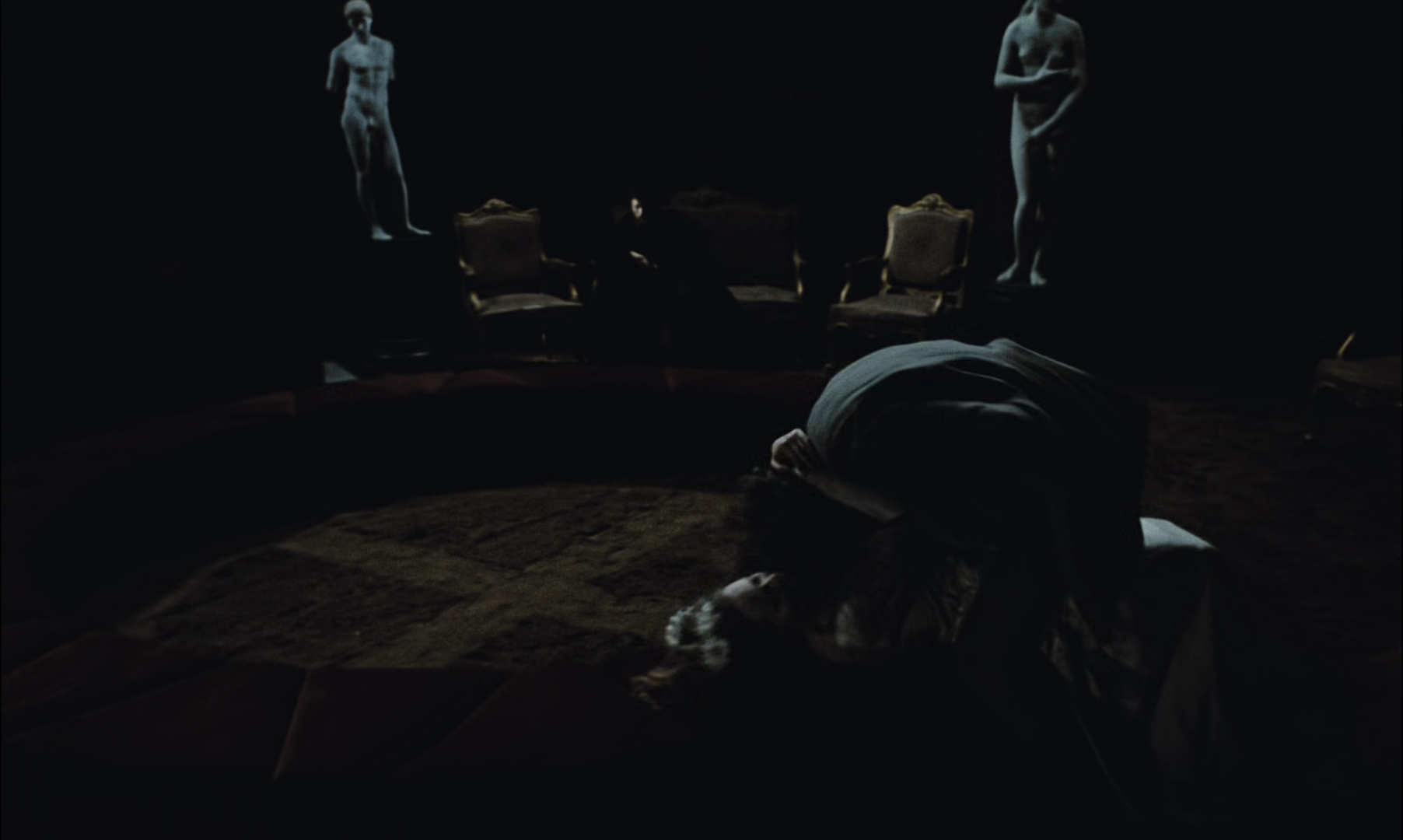
Fig. 1. The brothel from "The Devil." In the background, there are two ancient statues and barely visible, dark red curtain.
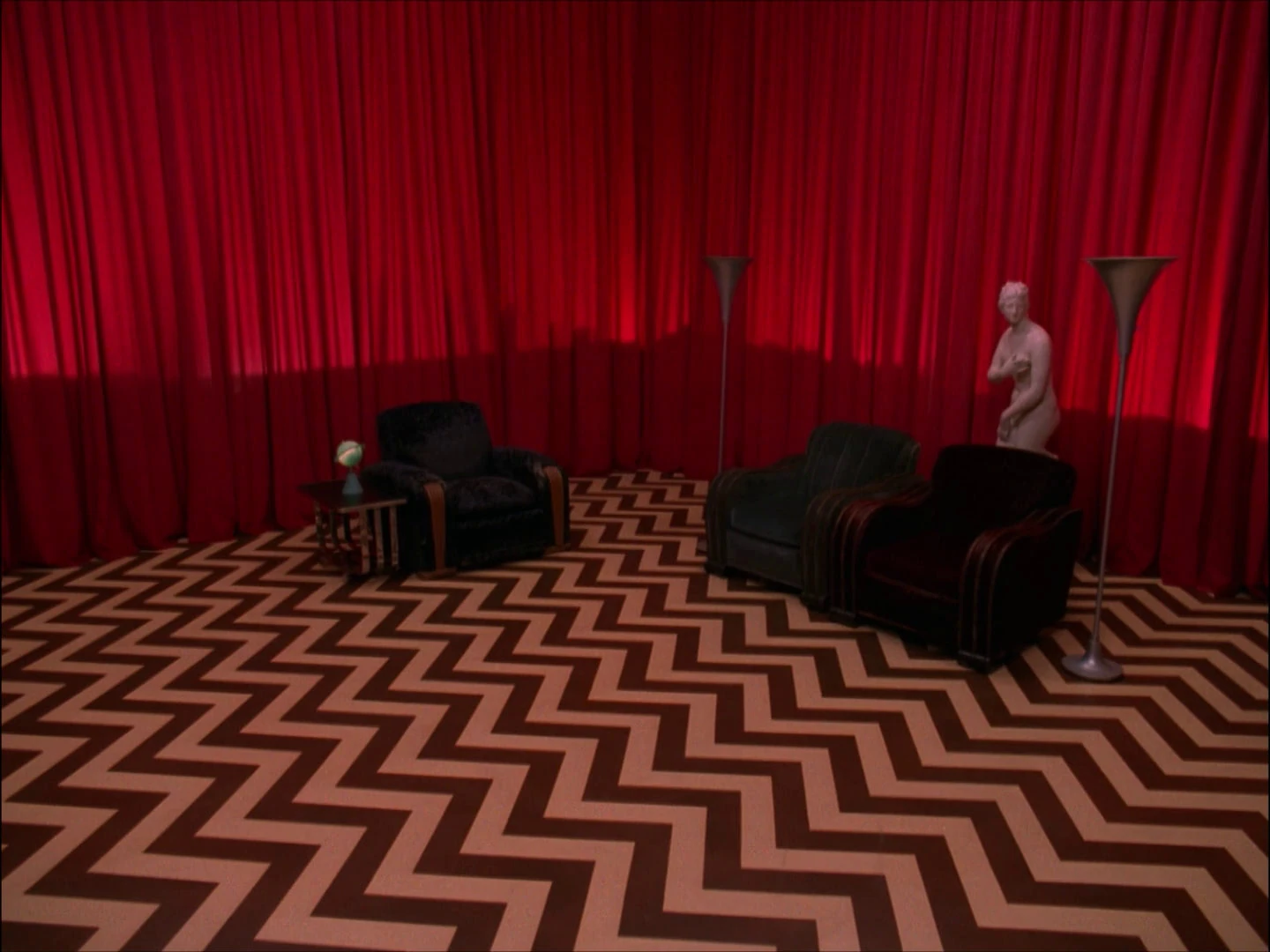
Fig. 2. Red Room from the Black Lodge in "Twin Peaks." There is an ancient statue and red curtains in the background, though lit better than the ones in "The Devil." This actually looks like the same statue! :D
And the timing is on track, too: "The Devil," 1988; "Twin Peaks," 1990.
And one more thing. We had the movie with English subtitles, and I gotta say that it was missing all the beauty of the language of the original. I've finished reading "Moby Dick" this year and I'm reading "The Difference Engine," so I know very well that English language has vocabulary to handle this properly. It's not like some blockbuster-consuming viewers are gonna stumble into this movie by accident. There's no excuse.
The same thing was with "On the Silver Globe."
Zapis zbrodni
"Zapis zbrodni" ("Record of the crime," but even IMDb has it under its original title) from 1974 is exactly what it says in its title: it's a meticulous and passionless recreation of a crime, heavily inspired by real events. As such, it's in the same league as Gus Van Sant's "Elephant." But above all, it's a document of its time, capturing harsh reality of the 1970s in Poland. I never heard of this movie before, and it's one of the best Polish movies.
You can see it on YouTube, but there are only auto-generated subtitles, which, even in Polish, are pretty much useless; we had them on to catch single words we didn't understand.
Basquiat
"Basquiat" from 1996 is a biopic on a 1980s' painter, Jean-Michel Basquiat, who also happened to be a friend of Andy Warhol; who is played here by David Bowie, and it was my main reason to see this movie. There is a lot of famous actors here, including the youngest Jeffrey Wright I've seen so far and a cameo from Willem Defoe. Apparently, the first movie about a painter *by* a painter. According to Wright, Basquiat was softened here. Nice soundtrack, though.
Castle in the Sky
Due to its 40th anniversary, I got to see Ghibli's "Castle in the Sky" in cinema! Ain't it a treat. I was planning to see it on Netflix, but things were happening, thanks to which I went into the theatre fresh. The first part reminded me of "The Difference Machine," of which I got to the last part, but later, it was like revisiting "Tears of the Kingdom," with floating castle, robots, and ruins. Other than that, it's Ghibli; top quality and all.
However, next time I go a Spanish cinema, I am taking those industrial ear-protecting headphones that I bough a couple of months ago, because the volume level was simply killing my ears.
Torremolinos 73
"Torremolino 73" (2003) is a Spanish comedy, about which I only knew that Mads Mikkelsen was there; before his international breakthrough in "Casino Royale." It's funny to hear him speaking broken Spanish. But that's later; the movie is generally a story about a marriage that accidentally ends up shooting adult movies, with a great success. And some real life drama in the background. A really good movie. And funny.
Also, I live close to Torremolinos, so there's personal connection, too.
The Mean Season
"The Mean Season" from 1985 is a film about which existence I had no idea, despite Kurt Russel playing the main role. A story of a journalist getting dragged into a dangerous game with a serial killer. Reminds me a bit of the Zodiac killer, while the pacing and vibe fall along the lines of Michael Mann's "Manhunter," and it got old well in a sense that it's not campy, which is not an easy feat for a movie from the 1980s.
An interesting thing is there is no exploration of the psychology of the killer: there are no attempts at showing what were his reasons, etc. And that makes it more believable in my opinion, because in the moment, which is what is shown on screen, there's no time for that.
Princess Mononoke
To follow up with Ghibli, two days later, we've seen "Princess Mononoke" (1997). It's a superb experience, but it is different from all the other Ghibli movies so far, because the main character is not a child; as a matter of fact, there are no children here at all. And that made the flow a bit different. And, just like "Castle in the Sky," players of "The Legend of Zelda" will feel like at home: especially Irontown is like villages from "Breath of the Wild."
This is something I did not expect from playing "Breath of the Wild" and "Tears of the Kingdom" -- that it would prepare me for Ghibli worlds. And it's not just "oh, cool" but much deeper immersion, when you can imagine how to storm the village or when a character is climbing somewhere, you can see the stamina bar dropping.
The Bride
"The Bride!" (2026) is Maggie Gyllenhaal's movie about the bride of Frankenstein's monster. The bride is played by Jessie Buckley, while Christian Bale is the monster, both amazing; the list of known actors is longer, including a husband (Peter Sarsgaards) and a brother (Jake Gylenhaal) of the director. The movie is a mix of comic-book and musical and gangster movies, and apparently, the mix didn't land well with many people. Might be a case of "mixed reviews first, cult following later," though.
Turkish Delight
"Turkish Delight" (1973) is Paul Verhoeven's movie, which is an adaptation of a book of the same title. It's also the movie with the youngest Rutger Hauer (29 years) that I've seen so far. The movie is categorised as erotic, probably due to all the nudity, including male full frontal, which is always a hot spot for the Usonian puritans, but I find this misleading. As if people haven't seen a penis. C'mon :D. If anything, it is a drama about loss. Sure, it is a bit over the top, but I can imagine someone having a story like that.
Body of Evidence
"Body of Evidence" (1993) is an erotic thriller with Madonna and Willem Dafoe. It tells a story of an attorney and his client suspected of murder; then they have an affair. A sadomasochistic affair, that is. That was too much for me, so I decided to see it for myself. The movie is bad, but at times so bad that it's actually good. Being 2026, the whole sado-maso turned out to be a slightly rougher sex with wax-dripping in one scene. Generally, watch it only if you know what you're stepping into.
Madonna is not a good actress, and while it could have worked for her in "Who's That Girl," which I still recall fondly, her lines delivery here was totally unconvincing. Willem Dafoe was the workhorse dragging the whole show, but even he couldn't save it.
The sex scenes got old, especially with soft-sax soundtrack from Graeme Revell. I find it fascinating that this was seriously considered a proper soundtrack. Kills half of the mood.
And speaking of sex scenes, there is this marvellously obsolete scene between Willem Dafoe and young Julianne Moore that brings exactly nothing to the plot. One could argue that Madonna/Dafoe scenes are a bit too much, but they kind of prove to be needed (when he realises during a witness hearing that Madonna's character is doing the same thing to him). The scene with Julianne Moore? Nothing. Nada. Apparently, she herself is embarrassed by it.
I can compare the movie to "Sliver," which came out the same year and also was an erotic thriller; though, there you could have cut off all the erotic scenes. It does seem that this kind of movies was ruled out historically as a dead end, and discontinued. And for better, probably. Both seemed to capitalise on "Basic Instinct" from the year before.
Weapons
"Weapons" (2025) is a horror with action set in a small town where one night 17 children run out of their home into darkness. While there is around two jump scares, it's not really that kind of horror; I think it would more appropriate to say there's more adult fear here at times, with children involved and all. I liked the structure: the narrative is split into chapters where each tells story from a new point of view, often overlapping with others. Solid genre work.
At one point, I thought it reminds me of "Barbarian," and it turns out it's from the same director.
I liked that the person playing the bad character was told two alternative interpretations of their character, and then, they had chose which one they're gonna use. A bit what Jim Jarmusch did with the letter in "Broken Flowers."
Picture Claire
"Picture Claire" is a Canadian criminal movie from 2001, with an ensemble cast, though Juliette Lewis plays a girl around which everything revolves. On one hand, the story is of a kind that Guy Ritchie or Quentin Tarantino could do; on the other hand, it feels very small-town: despite being set in Toronto, it feels as if it was happening on 2-3 streets in total. I've seen this movie over 20 years ago, and saw it now by accident. It also gives us scenes with Juliette Lewis and Gina Gershon. For some reason, I had a thing for Gina Gershon a quarter of century ago, so this was a big thing for me. There is also Mickey Rourke, but he's rather a so-called advertised extra. Big props for Callum Keith Rennie portraying a psycho sent after Rourke's character.
I also liked splitting the screen into many areas, which overlaps with photographic exhibition within the movie. I saw something similar in "Fargo," the show, but there it was used for switching from one place to another, whereas here, it's used for flashbacks and the mainest character putting the whole thing together (in case someone in the audience fails to do so).
But above everything else, it felt like the final movie of the 1990s. Now, being released in 2001, it's technically not a 1990s movie, but in the spirit, it is. The camera work, the plot, the action -- all that is 90s as fuck. And I say it as a discreet aficionado of the 1990s movies. It's probably not the best flick out there, and it was a flop, but if you like the decade, then it's a really crafty love letter that can give you a lot of pleasure.
Local Hero
"Local Hero" is a movie from 1983, telling a story of an oil-company salesman who's sent to Scotland to buy a whole town, so his company can build there a gasport. While the deal's taking its time, the man learns about the place, etc. The movie felt like a postcard from a simpler world, though I still can't say who the local hero was. Notable for Mark Knopfler's soundtrack. In one of the roles is young Peter Capaldi (a.k.a. the Tenth Doctor).
I read after the movie that there was backlash about the way the Scottish place was portrayed (it was one street with houses, and I can't say if this was a town or a village or something else). The grudge was that it was pictured as a backwater kind of place, but I think there are places like that in the world, in Scotland and everywhere else, and 43 years later, it doesn't really matter.
Apparently, the movie inspired some people to buy their summer houses there. Hotel works, too.
For years, I've been certain that the movie is from around the year 2000, so it came as a surprise that it was from the 1980s. After some thinking, I came up to a conclusion that the excerpts from the soundtrack have been distributed, legally, through Audiogalaxy, and I assumed at the time that it was from a new movie. It was not.
This gave the movie more value in my eyes, because it is capturing a world long gone, with different clothes, furniture, etc. This is always a big plus for me when I watch a movie.
A comment from Ighostrider:
'Local Hero' was filmed in Pennan, which is just a couple of miles from where I live and it still hasn't changed! It's still a very quiet backwater, with just one row of houses, and an incredibly steep hill down to it that made me scream the first time we ventured down there in the car! At low tide you can scramble around the rocks to get there from other inlets/bays. We still get tourists coming here because of the film. It's a stunning part of the world (but then I am biased!)
The Informant!
"The Informant!" is a typical Steven Soderbergh movie, which mixes a real case with not so serious portrayal of it. But then again, the whole story is unreal at times. A C-level employee (Matt Damon) of a food-processing company reaches out to the FBI about price-fixing happening in the firm. He agrees to go undercover for the FBI, and it seems to be going good, until the star witness starts coming off as unreliable. Then the story goes completely bonkers.
About Schmidt
"About Schmidt" (2001) is a film about a man whose wife dies and him coping with it. It's a very intimate story and, as I call it, a small-town. It was listed as dark comedy, but I think it's wrong. It's a quiet drama with some funny angles; because life's funny sometimes, too. Jack Nicholson nailed a man without characteristics. The sections where he reads letters to an African boy, often conflicting with what's on screen, were a nice technique.
The segment when he finally pulls his shit together and goes on the road in an RV reminded me of "Nomadland," which I saw in January. My wife said that if the political situation in the US ever settles, we should definitely do a tour like that. Go to all those diners and museums in the middle of nowhere.
But the biggest surprise was that this was not a creation of a Swedish or Finnish director! The pacing, the colour palette, the adventures that Schmidt encounters on his way -- it all screamed Nordic vibes to me. And yet, it has been done by an Omaha-born director.
I guess I'm getting older and older, but it landed really well with me.
Harry Dean Stanton: Partly Fiction
"Harry Dean Stanton: Partly Fiction" is a documentary about one of the most famous character actors, who landed only one lead in his career; if I recall correctly. I've seen some screenshots from this documentary over the years, and Harry Dean Stanton was always so stoic/Buddhist there that I just had to see it for myself in full. I find his approach to life very soothing. I'd like to get old with his dignity.
And the soundtrack is on TIDAL.
Three Colours: Blue
"Three Colours: Blue" is the first of Krzysztof Kieślowski's trilogy; apparently about France, but to me, it felt quite universal. The first movie tells a story of a car-crash survivor who has to put herself together after losing her husband and daughter. In this role, Juliette Binoche. I liked the narrative's unpredictability, as it's a mix of old Polish storytelling combined with more modern production and a French setting.
Dead Again
Kenneth Branagh's "Dead Again" from 1991 is definitely an odd one. For the most of the movie, there was something off, but I couldn't put my finger on anything specific. Then, almost at the end, it struck me that it's stylised as an older movie; namely 1940s/1950s Hitchcock movies, though that I learned after the movie. Due to that, as well as some unnecessary complications, the twist actually hits harder than it should have. But it's only for connoisseurs, in my opinion.
However, knowing that it's a 1950s movie made in 1991 makes it a more pleasurable experience. Branagh's a bit aloof detective and certain cheesiness between his character and Emma Thompson's make more sense, too.
But the most impressive are flashbacks, which are not only shot in black-and-white but look and feel as if taken out of an old movie: the camera work, the actors expression, everything. Quite an impressive feat, I gotta hand it to the director.
The Naked Gun 2½: The Smell of Fear
"The Naked Gun 2½: The Smell of Fear" (1991) is the second movie of the trilogy about Frank Drebin, one of the most peculiar cops in the history of cinema. I found this part to be funnier than the first one, but whether it's due to it being better or me being more in the mood, I do not know. And strangely enough, the plot about oil companies trying to sabotage a renewal-energy initiative got old like fine wine.
As previously, the characters do funny things up to the extremes, and often, funny things happen in two layers at the same time: one in dialogues and the other one in background events. How am I supposed to follow the plot? :D I had to rewind a couple of times. Please take a note that this is not a criticism; I find this hilarious.
The movie also has one of more realistic depictions, even if exaggerated, of what happens when you get under a car; once a common patent in action movies.
Three Colours: White
"Three Colours: White" is the second entry in Krzysztof Kieślowski's trilogy, but if I didn't know, I could have missed that. While there is Juliette Binoche in one scene, overlapping with "Blue," the tone of the movie is different. And it's set only partially in France; the action soon moves to Poland. It's funnier, and it was nice to see so many actors whom I haven't seen in years. Also, depicted Poland is ugly as hell, which shows me that it came a long way since 1993. And that's positive.
Naked Gun 33⅓: The Final Insult
"Naked Gun 33⅓: The Final Insult" from 1994 closes Leslie Nielsen's original trilogy about an aloof Lt. Frank Drebin. This time he's retired, but cannot let go. But let's not focus on a plot, which seems to be incidental and an excuse to show a series of disjointed sketches. As a whole, it doesn't really work well, albeit it's funny on a granular level. A slight difference, compared to the other two, are exact parodies of other movies.
The Waiter
"The Waiter" (2018) is a Greek movie about a man living quite a constant live with no thrills, not that he minds that, who suddenly ends up wrapped up in a criminal situation. But it's not how you think it is. Closer to Yorgos Lanthimos movies, as well as reminding me of "Buffet froids" with Gerard Depardieu. There is a lot of deadpan humour and slow pacing. I also like Greece as an action setting. The bad guy reminded me of Anton Chigurh.
Three Colours: Red
"Three Colours: Red" (1994) is the final instalment of Krzysztof Kieślowski's trilogy. After France and Poland, the action moves this time to Switzerland; not that I realised until my wife told me late into the movie. A young woman accidentally hits a dog on the road and tracks its owner, who turns out to be a retired judge spying on his neighbours. Then, an unlike friendship forms. I think this one was my favourite of all three; if I had to choose.
Three Colours: The trilogy
Now I kind of wish I made "Three Colours" reviews a thread. Never mind. To comment on the trilogy as the whole, I really liked how they're completely separate stories but overlap subtly. They're all so different from each other. Kind of amazing.
The old lady disposing of bottles with struggle is the only character present in all of them. I was so relieved when Valentine finally helped her in "Red." Note: I just read that those were three different people. But the scene is mirrored in all three movies.
I need to watch more from Krzysztof Kieślowski.
For years, I was avoiding his movies for two reasons: one, he was so praised by everyone everywhere when I was a little kid that I found this off-putting; and two, they weren't really playing any of his movies, not that I recall, and so I never revised my original sentiment. I would probably gave it a shot. It's only thanks to my wife now. I don't think I lost anything; I probably got more out of these movies now that I'm not young anymore.
Corridor
"Corridor" (2010) is a Swedish low-budget thriller about a young med student who gets into a relationship with his neighbour upstairs. What he doesn't know is that her boyfriend's part of the package. The early-digital quality reminded me of music videoclips from the early 2000s and David Lynch's "Inland Empire". Technology marched on and this kind of picture is no more. Maybe it'll return, like pseudo VHS did. I liked that the student wasn't playing a hero; it made him more relatable.
Akira
"Akira" (1988) got a 4K version and returned to cinemas, and I couldn't let it pass. It's been years since I saw it last time, and the memory distorted. Even the hospital scene with plush toys terrorising Tetsuo played out differently. This time I appreciated the soundtrack and the world-building more. The world's very bladerunneresque. Cyberpunk scenery-wise but without hackers. The plot also got old pretty well.
An after reflection is that "Stranger Things" borrowed a lot from "Akira," as well. Gifted children with numbers on their arms held in a military research complex? Yeah, it's all here.
Maybe I should read the manga.
Amateur
"Amateur" (1994) is another art-house movie with Martin Donovan and Elina Löwensohn, very much like "Nadja" from the same year. I suspect a collective here. Anyway. An amnesiac wakes in an alley and walks into the first café where he meets a former nun living from writing pornographic stories. She takes him in to her place and starts helping him. At the same time, a porn actress trying to get away from the industry tells us the opposite site of the story.
What I found interesting was that while the movie has all the elements of a thriller -- a troubled main character with a dark past, a femme fatale, two killers, and a bunch of typical subplots -- the way it's all shown makes it something uniquely different.
Plot-wise, it fell along the lines of "The Tourist", a show about a man waking up in Australia and having no memory of himself. Or anything else, for that matter.
Hydrozagadka
For a hot Summer Sunday, I decided to see "Hydrozagadka" ("Hydro-Riddle," I think I saw somewhere), a superhero pastiche from 1971. Ace is tasked with finding out what happens to disappearing water which leads him to a Bond-villain-like plot from Doctor Stain and maharajah of Kabur. The funniest thing is its atmosphere; though, you gotta know the realities of the 1970s Poland.
The creators didn't have budget left for credits, so an actress reads them in a theatrical manner at the beginning.
I downloaded the movie from YouTube and I wanted to link it now, but it's gone. Remember, kids, to always download movies from YouTube. It saves you ads and sometimes the movie itself, as we could see now.
In the Hand of Dante
"In the Hand of Dante" (2026) is Julian Schnabel's adaptation of Nick Tosches' book of the same title. It tells a story of a heist to steal the manuscript of "The Divine Comedy". The modern times are in black-n-white 16:9, while Dante's past is 4:3 and in a deliberate palette of colours. I liked Nick's voice-over, which gave me hints that it's gotta be based on a book. The heist part is there and all the elements are there, but it feels more like a pretext for another story.
The name of Julian Schnabel didn't tell me anything at first, but then it sounded familiar, so I checked and found that he was behind "Basquiat", which I've seen this year. He might have known Nick Tosches, too.
I liked Gerald Butler as a mob hitman. The actor definitely had fun playing him. If anything, he reminded me of a character from a stage play, not movie.
And because the action is partially set in Italy and revolves around art, the black-n-white section reminded me of "Ripley".
Project Hail Mary
"Project Hail Mary" (2026) tells a story of a scientist stranded on a rocket far away from Earth; to not give away too much. I managed to not know anything more than that, and it gave me a couple of surprises. As based on a book from Andy Weir of "The Martian" fame, the movie has a strong scientific backdrop. It is my kind of science-fiction. For most of the time, it's Ryan Gosling's monodrama; kind of topical to this writer: a single hero, alone, in space.
When I saw the tags attached to the movie, I was a bit concerned about it being "heartwarming", as often it's a cheap cliché in the spirit of Hallmark, but I'm glad I didn't get discouraged. Yes, it was heartwarming, but in a good way.
Dekalog
Inspired by the "Three Colours" trilogy, we continue with Krzysztof Kieślowski. This time we went with a series based on the Decalogue. An anthology set in the late 1980s in Poland that tells 10 different stories relating to the Ten Commandments. And because each episode is its own thing, I decided to treat it like 10 short movies. Which they are.
Hence, a thread.
Dracula 3000
"Dracula 3000" (2004) is a B-horror which is a loose adaptation of Bram Stoker's book but set in space. In the year 3000. Let's admit it: it's a bad movie. The production is low-budget, the plot is so-and-so, one-liners are beyond salvage and additionally butchered by the cast. And yet. I had fun. I heard it was not "so bad that it's actually good", but in my opinion it was bad enough to become good on its own terms. If you're a movie buff, you might get something out of it.
(Well, well, well. Nobody used the #Dracula3000 hashtag before me here. And by here, I mean my specific combination of federations. Fedi is big, so who knows.)
The movie is so bad that I'm not gonna mark most of the spoilers.
The outline of the plot is not that bad. A salvage ship with a crew of six gets a signal from an abandoned ship. They dock to it and go aboard and start finding out what happened. It looks like the action is anchored in the sail journey from Transylvania to England from the book. There is no crew whatsoever, which would be a creepy setting in a good movie. Not here though. Even a shadowy figure moving fast in the foreground didn't help.
An interesting solution that must have been cost-saving was using a real *sea* ship for the shooting. On one hand, it doesn't look anything like a spaceship; there are even bottles, etc., that probably were there. On the other hand, it doesn't look as cheap as made-up scenery with their budget would have done. And they had a lot of corridors to shoot. And a ship that was lost for 50 years would be in a rather desolate state. So, overall, I think this one's on the cooler side.
Despite its B category, there are actually four big names here. Sort of big. The first is Udo Kier who is the original captain and he's present in the action through his video logs; logs that the salvage crew doesn't really see that much. Then we have Casper Van Dien, of "Starship Troopers" fame, as a descendant of Abraham Van Helsing. Thirdly, there is Erika Eleniak from "Baywatch." And finally, Coolio the rapper as a notorious drug user. And yet, they act as if they didn't care, save for Kier.
And then, at some point, finally, Dracula shows up. He's named Dracula in the ship computer, but he introduces himself as Orlock. Like in "Nosferatu." But he's not bald. In fact, he looks like from a cartoon, in a cape with a collar up and black hair licked to the back. And he speaks theatrically. Granted, I don't know how I would behave if I was hundreds-years-old, but still. Not something you'd expect to see in space.
And speaking of Dracula -- spoiler ahead! -- there is no final fight with him. He chases the characters around the ship, killing two thirds of the already skeleton crew, but they manage to reroute the ship to fly into a sun instead of heading towards Earth. Very honourable. Two characters decide to have sex while waiting for that to happen [sic!], and the next thing we see is the ship exploding very briefly, immediately followed by credits. :D
There are two twists, though, that I can appreciate. First, when it turns out that Dracula didn't change Aurora (Erika Eleniak) into a vampire, she's incapacitated until she admits that she's actually a narc robot sent to investigate the crew. And second, when Abraham Van Helsing gets converted into a vampire and killed soon after. You'd think he and good ol' Drac would like to settle some unfinished business. But not in a B-move, they don't.
And that's it. I drank three beers during these 83 minutes and I had fun. Wait till the very end, because there is a scene after the credits. A cherry on top. An icing on the cake. Fitting the whole movie perfectly.
The Odyssey
"The Odyssey" (2026) is an epic adaptation of the famous Homer's epic poem. Apparently, Christopher Nolan wanted to do this film for 15 years. There are a lot of famous actors here, but somehow those are the same names as in another movies. Kind of a sad spot we're in. But anyway. I liked the non-linear structure and the sheer scale of it all. It really is epic. I've seen a lot of criticisms about the movie, and they're all stupid. Go see it for yourself. Now I want to read the book.
Just hours before seeing the film, I've read that the odyssey has been done as if it was a Viking saga. And I couldn't unsee it. The colour palette is indeed closer to the North of Europe than the Mediterranean Sea. With exception for Calypso's island maybe. I am not bothered by it in the slightest, as I consider this an adaptation of a myth, so any historic accuracy is just icing on the cake. And I'm there for the cake in the first place.
Some stupid things that the movie was criticised with: that the language is too modern and they should use the 19th century English, as if it was closer to the 8th century B.C.; that Elliot Page is not warriory enough; that Helen is black -- this might be the stupidest of them all, but it's funny how we're all, collectively, arguing again about Helen of Troy :D; that there are no gods, apart of Athena who might just be Odysseus's hallucination. There's probably more. But, fuck the critics.
As a side-note. I liked the Trojan horse. They usually make it stand on all four legs and a bit crude in shape, which I can understand for practical reasons. But here it's on its hind legs and really beautiful. And that makes much more sense for something that's supposed to be a gift. Why would Troy accept this clumsily made horse? But this one here? Easily.
And finally, the film's Argos resembled my dog that died this year, so scenes with him, especially the one where Odysseus returns home and greets his dog which recognises him and dies, landed really heavy for me.
The Public Woman
"The Public Woman" (1984) from Andrzej Żuławski is a film telling a story of a woman who acts as a nude model for hire but moves to acting. Then things got weird. I had trouble following what the plot is about. Midway through, a criminal subplot emerged and it was somewhat more comprehensible. I learned from the Wiki after the movie that it was about losing track of what's real and what's not. In that aspect, they succeeded. :D
I really liked this blurring of reality and fiction, though. Yeah, I caught that to a degree on my own. So, there is a number of scenes where characters talk to each other and we suddenly learn that this was a movie being shot, because the camera zooms out and shows in-story camera and crew.
Also, an observation. The main character spends a lot of time naked, almost as if this was some sort of the director's fixation. While some of it might be explained, a lot cannot. Oh Andrzej, you dog.
Emmanuelle (2024)
"Emmanuelle" (2024) is a film from the series about *that* Emanuelle. It is, however, a reboot, so no need to see any earlier films. Alright, so this is an erotic movie. Right? Well, in a very ancient sense, it is. Emmanuelle has some erotic encounters, but few and in between of weird, Lost-in-Translation-like wandering here and there, mostly in the hotel that she's auditing. As for an erotic movie, there is surprisingly little sensuality. It is a movie for nobody.
I have seen only the 1974 "Emmanuelle" before, so I could compare it only against this film. There is a sex scene on the plane, though plays out differently. It's probably the only scene I remember, apart from the one with an Asian stripper smoking a cigarette with her butt, a scene which is absent this time. A shame, really. But even by the year 2000 standards, the 1974 movie was not very exciting. It was the first porn in cinema, as far as I remember; otherwise, it would be forgotten.
Alright. But can a movie buff can take anything out of it? Are there any redeeming qualities? Well, yes. If we forego that it's supposed to be an erotic movie -- or even a romantic drama [sic!] as HBO Max tags it -- then it's not as terrible. Emmanuelle has this washed-out inertia about her where she lives a comfortable life but finds herself not really up to it. Judging from her call with her mother where she tries to convince her daughter that she has a good life, it has been going on for a while already.
And then, the setting. There is something about hotels. Let me paste here a quote from a material about liminal spaces that I have seen in August 2024:
"I really enjoy just existing in hotels. The Long Identical Hallways. The Soulless Abstract art, the Weird noises the air conditioner makes. Strange City Lights in The Window. Six Stories off the ground. Strangers chatting in the hall: Nothing in the dresser. No past, but an infinite present."
If Emmanuelle was auditing hotels for living, then she might have felt trapped in this tasteless infinite present. When she finally -- spoiler alert! -- breaks out of it, she goes to the opposite scenery. Chungking Mansions. Tight, intensely dense habitation packed with people. She's finally free. She's outside. This marks two parts of the story: she starts trapped in liminal space and ends in the messy but real world. There was a potential for something else, but they tried to make it erotic. :D
I don't think that the director intentionally tried to allude to liminal-space aesthetics. It's just that liminal spaces extract this vibe from hotel-like places. A coincidence. That said, there is one scene where Emmanuelle tries to follow a man she's fascinated with and she ends up in a hotel pool that looks like taken out of the Poolrooms, one of the sub-aesthetics of liminal spaces. One scene wonder, really. But fits perfectly.

There are interesting characters in the film. But not too many. There is the hotel manager (Naomi Watts) who's doing her best. There is an escort girl using the hotel as her hunting ground; with a tacit permission from the said hotel manager. And then, there is a mysterious man whom Emmanuelle saw on the airplane in the beginning. She has quite interesting interactions with all three. And really, there was the potential there.
This falls under an observation that I've read a couple of years ago. Films don't really need erotic scenes. There are a couple of exceptions, but largely, just don't. In the 1970s, maybe there was room for groundbreaking in these regards, but the revolution happened, even followed by evolution. We have porn streaming services and whoever wants to see some action can do that. Emmanuelle without erotic scenes sounds like out of place, but this is where we are.
And finally, the finale felt random and abrupt. In the light of what I just wrote and read at the same time, I can see what it tried to achieve, but no. And the funny thing is that on paper it doesn't sound bad: Emmanuelle has sex with Kei's (the mysterious man) friend, who doesn't speak English, so Kei needs to translate for Emmanuelle. She tells what the friend should be doing to her and Kei repeats that. Reminds of a similar thing from James Ballard's "Crash".
So, to summarise. There was potential, there were solid characters, there were really carefully selected visuals and aesthetics, but in the end it was a dud. Not sure I can recommend it. The movie has its appeal, but not the way it intends.
Kiki's Delivery Service
"Kiki's Delivery Service" (1989) is Studio Ghibli's anime. 'Nuff said. The plot follows the structure that we could have seen in "My Neighbour Totoro", with a very long introduction taking almost the whole movie and the action starting only for the finale. I suppose it works better for kids. There is no villain here and instead we have an accident with a zeppelin. It's a very comfy watching. I wasn't planning on seeing it again, but you don't say no to Ghibli in cinema.
For some reason, Kiki has been renamed in Spain to Nicky.
If you're interested in an adult movie with a very long introduction, compared to the actual action, go see 2000's "Sexy Beast". But, like, not *adult* in this sense. It's a gangster movie.
But, coming back to Kiki and Studio Ghibli, I have to remark how marvellously they catch the essence of Europeness. The buildings, the clothes, the vehicles, etc. All that screams Europe to me. And yet, it doesn't resemble anything specific. The town from "Kiki's Delivery Service" feels vaguely Portuguese, but this could be because I've never been to Portugal. Kind of sad that this kind of external perspective on something is dubbed appropriation and fought off these days.
One moment later...
Now I'm reading that it was supposed to be Stockholm. :D In my defence, I have never been to Sweden either, let alone Stockholm. But the point still stands. They know how to capture the spirit of the place with an outsider eye.
MCU Spider-Man
For reasons that are not important now, I have avoided Spider-Man movies for years. Decades even. I made an exception for 2012 and 2014 movies. And then there were MCU movies where he guest-starred. But generally, I was in the dark. This changed this week, because my daughter asked me to take her for the newest one to cinema, and I decided that I don't wanna go blindly.
Hence, the thread.
Superman (2025)
"Superman" (2025) is another attempt at bringing the Man of Steel to the big screen. I think it's a difficult character to adapt, because Superman himself is a bit of an outdated boy scout. But James Gunn knows his shit. The film starts in medias res; there are no origins or anything. Even the subplot with stopping the war is served to us in a dialogue. After a bit wonky opening, the film gets better. It strongly feels like old DC comics. Which I can appreciate.
I was not that eager to see it, but I saw Krypto the dog on a trailer and this got my attention. Generally, by the late 1980s, DC killed off all these Super Dogs and Super Boys and Super Girls that were plaguing their comics. Since then it was mostly Super Man. There was a smart introduction of Super Girl in "The Flash" (2023), but Gunn was like, "Fuck it." And he went with an actual dog in a cape. Bold move.
Watching the film side by side with Tom Holland's Spider-Man allowed me to see the difference between Spidey and Supe. DC seems to be more detached from our world. They have their own countries and metahumans are centered less about mutations. Their powers are often inherent, which places them closer to the European comic. Only a little, but still.
David Corenswet as Superman looks very much like Henry Cavill, just younger. Not necessarily a bad thing. It looks like Superman has a very distinct looks which are not subject to any modernisation. Even the suit is blantantly 1940s, with red underpants slightly loosely hanging off the rest. As shameless as Krypto.
Nathan Fillon plays a jerky-idiot version of Green Lantern. Zero respect here, but somehow it makes him more realistic?
I didn't know Mr Terrific, and it's such a good character.
Lex Luthor is played by Nicholas Hoult whom I just saw in "The Great", and he kind of plays a similarly grandeur character. Although, Lex Luthor is more competent. The opening where he dictates Ultraman what moves to do to successfully fight off Superman was a brilliant way of showing his obsession with Supe.
Ultraman's initial look reminded me of Doomsday when he showed up first in the 1990s. Defo not a coincidence.
Do I recommend the film? Hell no. It's a classic comic-book adaptation and it's done craftly, but I feel as if I outgrew this type of stories. If you like it, you don't need my recommendation. If you don't like it then go watch something else.
Now I am curious about the follow-up "Supergirl", because it's set in space and reminded me of "Guardians of the Galaxy", James Gunn opus magnum. And we're gonna get Lobo too. So. I needed to see this film for the broader context.
Because yes, Krypto is Supergirl's dog. Which I found a smart way of introducing it to the film without making it too campy. Krypto's just passing by.
Mortal Kombat II
I was not keen on seeing "Mortal Kombat II" (2026) after the first film, because it was generally a mediocre experience. But then I heard good things about the sequel, and I caved in. Creators took criticisms to their heart and reconfigured how the story is told, etc. And it shows. It really shows. This probably means that if you didn't play the games, there's less for you. But not everything should be for everyone. It's campy as hell and fun to watch. If you're the right viewer.
The main point of criticism was introducing a canon foreigner to be the main character. It's Mortal Kombat and you have tens of characters and you don't need to make anyone up. The rationale could be creating someone relatable for newbies, but this doesn't really work, rather tells us that there was critical failure on understanding what kind of film they were doing for whom. This was rectified now. The canon foreigner was killed. Not unceremoniously, but still, he had to go.
Instead, we're getting Johnny Cage. I gotta be honest, Johnny never was a highlight of the game for me. My main focus was on the Sub-Zero/Scorpion line. But apparently, Cage was not included in the first film because he would have been too much. Now he's in, and while there is no main character this time — quite aptly for Mortal Kombat — he is important. Karl Urban plays him over the top and not without some goofiness. The introduction through an old action flick within-the-film is hilarious.
Hilarity follows the viewers on almost every step. The amount of cheesy one-liners is amazing. And they come in two types; one are cheeky one-liners and taunts, but the same style was kept also for various backstory exposition. Lord Raiden going deadpan serious with the lore really is a cherry on top. In these regards, the film is not pretending to be anything that is not. It's not a drama, it's not an epic story. It's a videogame as a film. A little plot, nice visuals, and a lot of action.
I always thought Kano to be underutilised in the MK films, because I think he's too far from the whole tournament story. There is a potential there, but in current configurations, he's demoted to a secondary character. With these amounts of characters available, concessions had to be made, and it's hard to be upset about that. "MK2", however, made him a comedic yet cocky relief. An interesting move that gave him more presence.
Sub-Zero returns as Noob Saibot. And there is Scorpion, too. There wouldn't be Mortal Kombat without these two. I liked how Noob Saibot splits himself into two entities.
If I had to name the most main character of them all, it's gotta be Kitana. While she doesn't get more screen time, she has the arc spanning from the prologue to the finale. Gotta admit, I never really played her character in the games, but being Shao Kahn's daughter obliges.
But the biggest winner are the visuals. Many earlier MK films were using film language to present the fights. It's okayish, but too much is lost in translation. In "MK2", however, the framing is closer to a fighting game. For the first time, I think. The fighters are generally in one line, as if in a 2D game. The backgrounds are over the top. There even is The Pit from the first game. There is no in-world explanation for that, so it's an artistic choice. And it delivers hard.
The other realm visually looks like inspired by the 90s. A lot of fantasy settings, when thought to look campy, reach out for the 80s vibe. But not here. The buildings and the architecture look like from a 90s fantasy show, just done really well technically. It might be the first time when I see the 90s used as aesthetics so well.
It will be interesting to compare them with the upcoming He-Man film and how they tackled this there.
So, if you played games and liked them a lot, this is probably the best big-screen adaptation of the whole franchise. Very close to "by the fans, for the fans". It fixes what the first film broke and delivers fun.
Faust
"Faust" (1994) is a trippy ride from Czechia. It generally tells a story of Faust and his deal with Mephisto, but the framing device is just bonkers. There is a nameless man who get a map handed too him in the street, with a spot marked on it. He goes there and ends up in a theatre where the play about Faust is played. And he becomes the actor and the character at the same time. But he also gets out of the role. It's as abstract as I just described. I really liked it.
It heavily reminded me of a clip for Moby's "Honey", where Moby goes into places, like under a bed, only to get out somewhere else. The clip was so suggestive that it inspired me in high school to write a whole book happening like that. Therefore, "Faust" felt very familiar to me. I like when something feels like mine. It shows me there are like-minded people out there in the wild.
I also liked that film heavily leaned on showing, not telling. The first line of dialogue is late. And generally all the spoken words are from the play within the film.
As the film was shot in Prague in 1994, it fits nicely with realities shown in Krzysztof Kieślowski's "Dekalog". Funny how nostalgia works. I wouldn't like to go back to that, but as a film setting it brings rather fond feelings.
And lastly, the whole Honey-inspired experience reminded me of the Backrooms. Both literally and conceptually. Literally, because the backstage of the theatre looks like the 90s Central European Backrooms. Conceptually, because of non-Euclidean geometry: the man opens the door and goes to one place, then returns, and opens the the same door again, but this time they lead elsewhere.
Once again I am reminded that the Backrooms didn't just pop up a couple of years ago. Then they only emerged.
Five Nights at Freddy's
"Five Nights At Freddy's" (2023) is a PG-13 horror film based on a series of popular games that conquered the Internet. As it's basically for children, don't expect anything drastic. There are a couple of jumpscares but that's it. They created real animatronics based on those from the game, and that was a good choice. They were able to make them scary mostly through what they do with their eyes. I wouldn't watch it for myself, but it's a fine watch with a younger generation.
I would place "Five Nights At Freddy's" among films from fans for fans. And probably by fans, too. It doesn't pretend to be anything more and it delivers what people want. That the film critics will not see much value in it is irrelevant. The film earned enough. And, what I think is important to highlight, it's a Blumhouse production. Now, they now how to do a solid horror according the genre's rules.
But there's more. I found a lot of adult fear here. The whole setup of a man having trouble with keeping a job while having to take care of his little sister who doesn't want to talk to him hit me harder than the animatronic animals. And then there's an aunt in the picture, who wants to take the whole custody over the sister. This is what drives Mike, the main character, to take a job as a night watch at Freddy Fazbear.
2046
"2046" (2004) is a Wong Kar-wai film about, well, coping, I guess. It starts like a science-fiction film and it seems to be a framing device, but midway through the film it gets explained that it's a plot of a short story that the main character writes. Nice distraction. To me, it was a delicious journey of a man into his past. It's not linear, it goes back and forth, aiming for the clarity of his situation. But it's all from a safe distance.
Gabbeh
"Gabbeh" (1996) is an Iranian film about a young nomad girl and her way to love. I liked the framing device, where she shows out of the blue on a gabbeh (a type of carpet) and tells an elderly couple her story. I assumed that the nomadic life has been pictured accurately, so it's interesting to see how differently people live, or lived, out there. Visually, it's all very fluid, like memories.
The English translation was very good and brings poetry to the table. At times it felt like a poem and at times like a fairytale.
Five Nights at Freddy's 2
"Five Nights At Freddy's 2" (2025) follows the story of Mike and his sister Abby. The Freddy's pizzeria is closed, but between film the bad aunt made a fuzz and everyone knows about animatronics. In a very Halloween-like frenzy, the whole town dresses as Freddy, Bonnie, Chica, and Foxy. It's still PG-13, but the creators managed to avoid the same killer returning to continue his killing spree. And this time, for a change, there is a segment based on the actual game. I sense it was pointed out by fans in the first film.
Two stingers clearly tell us that there is going to be film number 3. It makes sense if you look at the earnings versus the budget. It is a kind of film that gives its viewers exactly what they want. Everyone else liking it will probably be accidental. Which is fine. I always respect stuff done for your own people. They don't have to pretend anything, because they know their audience in advance.
And it's Blumhouse, whose craft I respect.
Dust Bunny
"Dust Bunny" (2025) is Bryan Fuller's feature debut. A story of a young girl whose parents get eaten by a monster from under her bed. To deal with it, she hires a professional hitman living across her apartment. Then things get complicated for a number of reasons. If there ever was one film to be categorised as fantasy, it would be it. And, coming from Fuller, it's a visual wonder, starting from colours and ending with costumes. And the monster.
The beginning got me wondering if it's not a children film, but when 5B begins his side-investigation, it becomes an adult film. Not because they swear or something but because I think it's too much talking and it would bore children.
There are a couple of scenes that clearly allude to "Leon: The Professional". The hitman/girl duo, but also the fight in the apartment when 5B hides on the ceiling.
It's nice to see Bryan Fuller and Mads Mikkelsen return to cooperation. They worked previously on "Hannibal". And Sigourney Weaver is good too. But the main drive is pretty soon established to be Mads and Sophie Sloan. Really cool dynamics between actors.
Backrooms
"Backrooms" (2026) is Kane Parsons (a.k.a. Kane Pixels) feature debut based on his web series about The Backrooms. The knowledge of the series helps a little with the origins of the place but is not necessary for watching. I was concerned if it will hold as a film, but it's good. The Backrooms part is obviously solid. They actually built them this time, as opposed to web-series blender-rendered world. The cast is minimal, with almost no extras. This helps for liminality. As the Backrooms alone wouldn't work for a wide-audience film, there is a character of Clark the furniture store manager, his assistant, hey boyfriend, Clark's therapist, and Phil from the Async Reasearch Institute. All but Phil discover the Backrooms without prior knowledge, so people from outside the lore can follow their journey with equally fresh eye.
Visually, it's a gem, with the colour palette and clothes and furniture and cars being the early 90s as fuck. There are two camcorder sequences as we would expect from the found footage origins of the series, but the most of the film is normal. We get to see the proper Backrooms not filtered through VHS for the first time.
Gone from the film is the explanation about the infinite storage room. I like it, but it would be too weird for normal people. They're not ready yet. And that's not bad, because instead we get Clark explaining Mary that the place they ended up in is like rememoried places (or people). "It's every place that ever was." As is, it reminds me of this music project illustrating dementia. There was also a Doom map like that.
Worldbuilding-wise, "Vivarium" comes to mind. Especially the part at the end when the girl gets out of bounds. "Vivarium" had a completely different colour palette, though. It was a nice attempt but was not quite there yet. "Backrooms" lands where it should. We'll probably get more, and the future instalments might go more technical on details. By then, only interested people will follow.
3 hours later...
The more I read about the film on TV Tropes, the more I realise it's very much like Stanisław Lem's Solaris attempting to copy humans. There's an extra twist here with distorting memories over time. Which is very much how memories work for human beings, too.
Incidental probably, but it could be also used as an illustration for model collapse in AI.
Good Luck, Have Fun, Don't Die
"Good Luck, Have Fun, Don't Die" (2025) is a science-fiction film where a man dressed in a plastic coat enters an LA diner to tell all the gathered there that he's from the future and he needs six people for a mission to change the said future. It's well written and well shot, with my favourite Sam Rockwell in the main role. There is time-travelling but we see only one loop in the film. In a way, it's the new iteration of "The Terminator" that we all deserved. It captures the essential.
Mad Love
"Mad Love" (1985) is Andrzej Żuławski's film about gangsters killing other gangsters. Roughly. But that emerged over time. For a while I was not able to tell what's going on. Everyone's acting crazy and, as always, there are naked women too. It's a loose adaptation of Dostoevsky's "Idiot" which explains the main character. Only for hardheaded film buffs, in my opinion.
Suspect Zero
"Suspect Zero" is a 2004 film that starts like a story of a serial killer and an agent chasing him, but soon things complicate. I really like this film and it's at least the third time I've seen it. It quickly evolves into something that could be an X-Files episode, in a good way. Ben Kingsley seems to be having fun here and he and Aaron Eckhart built nice dynamics together. Carrie-Ann Moss however is largely a glorified extra.
I find the film visually very appealing and this time I found out that the director made two videoclips for Marilyn Manson's "Antichrist Superstar" era. And that was exactly how the visual style felt to me.
The film was largely a flop and has low Rotten Tomatoes percentage, but I don't care. It's one of those films that you've seen at some point of your life and it stayed with you. On the plus side, it's still rewatchable; not something I can say about many other films like that.