PSX Doom
2026-06-11
After making PlayStation Classic play a wider variety of games, I had unlimited options. I could've played anything from the large library of PlayStation One. And I chose Doom. Yep.
And this thread will document my journey.
(Yesterday, after an hour with "No Rest For The Living" on PSX, I asked myself, "Why the hell do I even bother with other games?")
Now, I played PSX's "Doom" as well as "Final Doom" a couple of years ago, thanks to PsyDoom, which allows playing PlayStation Doom files on modern PCs, offering modern controls, high-res, and a vast number of quality-of-life fixes. If you want to predominantly see the PlayStation's Doom content-wise, I strongly recommend that. It should save you a lot of frustration. I did this and couldn't be happier.
But now I'm older and I wanted to see the original PlayStation Doom Experience for myself. At least in the US, this was the first Doom for many. It looks differently and it sounds differently and controls differently, so it's another kind of beast.
But let's start with a bit of history.
The Jag fork
Doom had many ports, and we're talking here about over 100 different attempts. Some of them were commercial, many of them were projects started after the code has been open-sourced. The commercial path is interesting, because all the 1990s console ports were forked from the one made for Atari Jaguar. And because Atari Jaguar was not as powerful, it came with much simplified mapset: there was cruder geometry but also whole sections cut off.
To illustrate it, here are layouts of "Pandemonium," originally E3M3. As you can see, a lot of concessions were made at times.
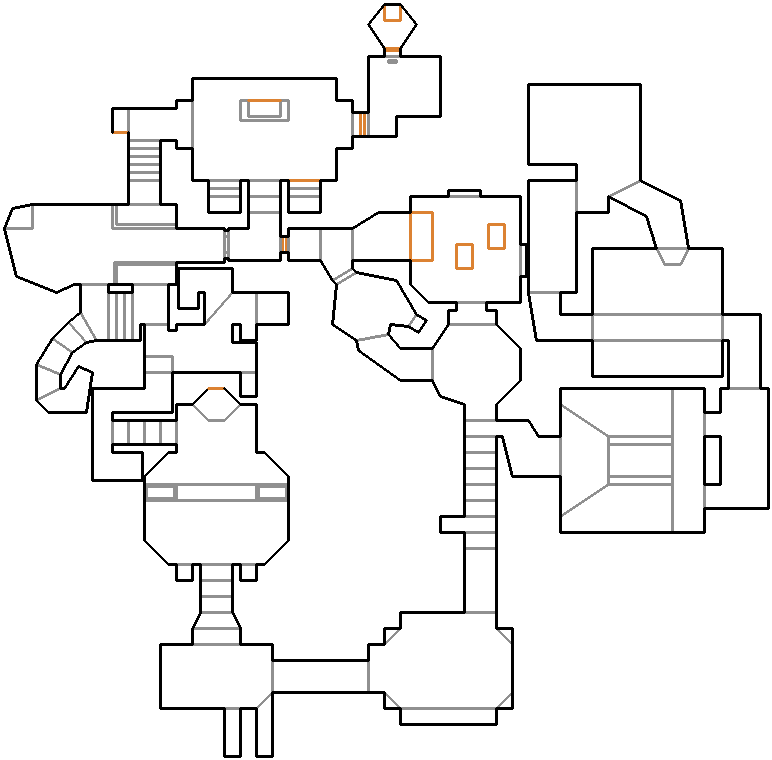
Fig. 1. "Pandemonium" (console map 18).
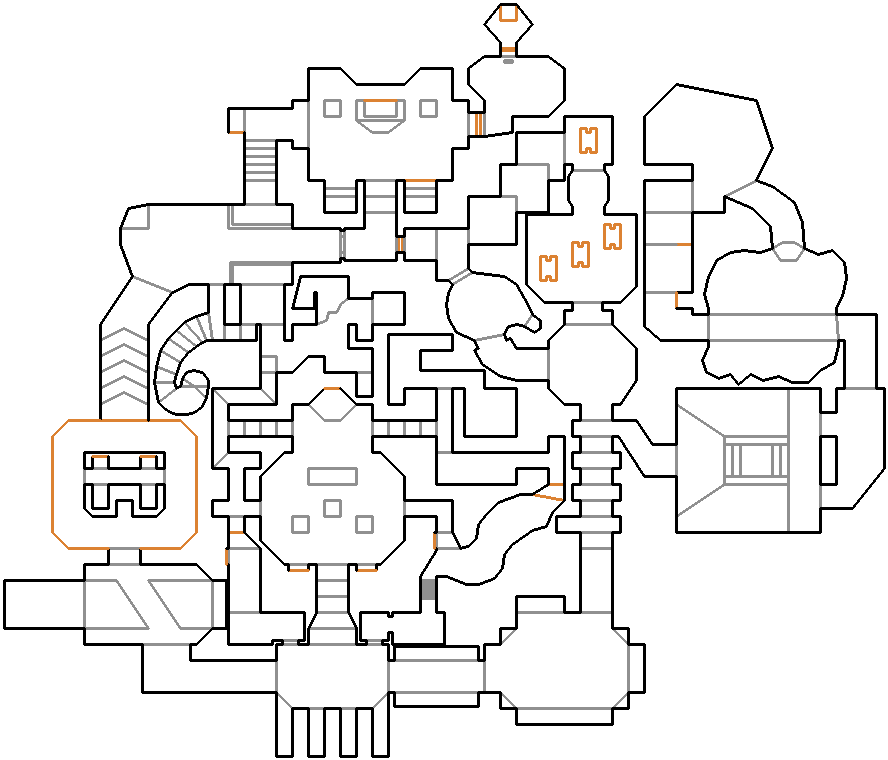
Fig. 2. "Pandemonium" (E3M3) from the original PC version.
BTW: This reminds me of the recent "Heretic + Hexen" remaster, which made the opposite thing and expanded maps geometry, to discontent of some; but I liked it.
This had an interesting effect: because I was playing PSX levels years after the PC version, I had only vague memory of how they looked. So, when I was navigating the levels and things looked differently, I was not sure if they simplified it that much or my memory was deceiving me. And that's on top of a different texturing in many places; they had to save the memory.
And while PlayStation could handle more complex maps than Atari Jaguar, re-using them saved developers' time. This applied to "Doom" maps only, though: there was no "Doom II" for the Jag, so those had to be done in-house. And they carry fewer changes, mostly visible through their height; but we'll get to that. Still, the biggest ones were omitted, like "Downtown," "Industrial Zone," or "The Living End."
PSX port
However, where PSX lacked in the scale of things, it made up for it with the visuals. Apparently, when the Sega Saturn port was being done, John Carmack requested the renderer to be software, and it came out so-and-so; he later backed out on it, saying it was a mistake to insist on that. The PSX dev's had more freedom, and they incorporated some effects that the hardware offered. This, in turn, gave everyone a more unique experience. The most visible change were coloured sectors: each sector of the map could have a coloured filter applied; there was for sure yellow, (dark) blue, red, and green. That could allow to vastly differentiate between areas. Green was applied for slime pools, red for lava, dark blue for dark rooms, and each door requiring a key had this colouring applied, too. I find the result very neat. If I could port one thing back to PC, it would be it.
BTW: If it sounds like "Doom 64," it is because PSX Doom was later used as a base for the N64 port. If I recall correctly, the PSX port was technically an outcome of experiments while preparing "Doom 64."
Textures got downgraded, or rather: upgrained. I can't fully say what's so different about them, is it less colours or bigger pixels or something else altogether, but I could clearly see on PsyDoom that they were cruder. It actually gave the game more retro look than the actual Doom has; which holds pretty well, especially in higher resolution nowadays. It could be that they also re-used assets from Jaguar. Not that it mattered much on a CRT TVs where the game was played.
To my awareness, nothing was taken from the enemies sprites. Apart from some enemies cut off, as well (Arch-vile didn't make it).
Whereas visuals were altered to a degree, the sound was replaced in all aspects. PSX Doom had not only a different soundtrack, but also all the sounds: monsters, weapons, doors, pickups. Everything. Gone. From what I recall now, the company behind the port didn't want to pay royalties to Bobby Prince, who not only composed the original soundtrack but also prepared the sounds.
It's kind of curious that from this cheap move came out something so interesting.
All the sounds were later used in "Doom 64," so if you played it, you know how PSX Doom sounds. Same with soundtrack. For the music, Aubrey Hodges was hired, and he threw away the whole metal-based approach and went with ambient soundtrack, which is notable because it happened before "Quake." And when I say ambient, I mean hellish soundscape with samples of crying children. It definitely is fitting the game setting.
A new behaviour was programmed for the PSX port: there is reverberation for sounds that happen "inside," whereas "outside" areas sound like the PC version. The inside and outside in Doom are defined by the ceiling: if it's sky, then you're outside; otherwise, you're inside. To me, it's discreet, and with different sounds that, to be honest, sound like coming from a well, it's closer to trivia. But still interesting trivia. It shows that it wasn't a simple cash grab.
The HUD got redesigned and uses darker background, bigger letters, and the super shotgun finally got its own slot (and became weapon number 4; no surprise here). It doesn't show all the ammo numbers, though.
An interesting improvement is displaying the messages just above the HUD, instead of the top left corner. It makes reading those messages easier, as your eyes don't need to jump up to the top and back. It's closer to "Quake," which would display important information in the middle of the screen.
Map-wise, "Doom" had 59 maps, because it combined "Doom" and "Doom II," with some omissions but also some additions (like my visually favourite "Hell Keep"). The "Doom" part is not split into episodes, so gone are the remnants of the plot revealed at the end of each, and it will move you to "Doom II" upon completion, preserving the gathered arsenal. You can, however, still start from "Doom II," though fresh.
"Final Doom," however, was more of a cash grab. Yeah, it happened in the end. That version might have fixed some bugs, but map-wise, it's mostly Master Levels [sic!], then some "TNT: Evilution," and only then 6 maps from "The Plutonia Experiment," also known as simply "Plutonia." And there are only 30 maps in total. There was no sense of progression, and it ended with an early level, though I suspect because there's Cyberdemon there, so it made up for a boss.
2026-06-13
PsyDoom
As mentioned, I played both through PsyDoom, because (a) I didn't want to be bothered with setting emulators (how the tables turned since then), and (b) I didn't want to deal with the ancient controls. I wanted to see the PSX Doom world for myself in the first place. The modern and refined experience was a perfect way to do that. I also played a new level made for the port, including Arch-vile and removed limits. And trampolines; the map had trampolines, a Rise-of-the-Triad approach to jumping.
The map in question is "Caldera of Wretchedness," and you can download it here: https://www.doomworld.com/vb/thread/125239. It doubles as the engine demo. While looking for this link, I found out that there are some more projects.
Small-town Doom
It's been 2-3 years, and the memory is not fresh, but from what I remember -- apart from this implanted-memories impression, which I wrote about earlier -- I had this small-town vibe. There is something specific about small towns, a certain atmosphere, and PSX Doom has it. It's like going from a big city to a small town and seeing generally the same types of buildings and places, but they're just smaller.
This was of course due to working against the technical limitations. Like the height, which was lower. PSX Doom could display a wall 256-pixel high, so many maps lost its height. Now, "Doom" was not so tall, and this wasn't that visible, but the original "Doom II" vastly expanded in this aspect. And now they had to take it back again. The pits were not deep enough, which was hilarious, because they changed from inescapable ones to more like damaging rivers. In a couple of places, where the map-makers wanted to maintain the height, a wall would have been split into 2 times 256 pixels each; which is not a new technique, because this is how the Icon of Sin in "Doom II" was built. Limitations breed arts of different types.
The maps were also more secluded. As a matter of fact, the game could crash if there were too many monsters at the same time on screen (or active; I don't remember), which had a tendency to happen in "Suburbs," for instance. But this further contributed to the small-townness of the atmosphere. While being not so densely-populated is not inherent to small town, that is how they look like in the world with inverted demographic pyramids.
In other words, all was in place.
Master Edition
And that's how we're arriving to "Master Edition," which is a collection of All Those Levels That Didn't Make It to the original PSX Doom. Doom has a very ambitious community, and just because it couldn't have been done by devs and map-makers back in 1995, it doesn't mean it cannot be done at all. And Team GEC decided to do the undoable. As of 2026, it's still at Beta 4 stage, but (a) there are most of the maps and (b) it's still being worked on.
But here's the best part: it can run on an actual PlayStation 1. If you have it. But it also runs on emulators, and that's easier. One of the first things I tried on my R36S was that game. And it worked! But the controls were too much for me. And for two reasons: one, the PSX controls themselves got old a bit bad; and two, R36S is not a convenient device to play games like that, at least for me. So, after dying a couple of times, I gave it a rest. But I did not forget.
I played a couple of maps with PsyDoom, like "Pharaoh" and "Caribbean" from "Finald Doom," and "Altar of Extraction," which was extracted from the 3DO, the most infamous Doom port. And that wasn't even a finished map! But, nothing is impossible for the Doom community. However, I didn't follow up much more. I think I challenged "Fear," the secret level from "Thy Flesh Consumed;" challenged successfully. But after that, I went after something else.
But with PlatStation Classic, I thought I could give it a shot again. I am not up for re-playing the official releases, though; maybe someday. Apart from seeing how the missing maps were adapted for the PSX Doom limitations, I wanted to experience the controls that players had in 1995. It helped that PS Classic came with replicas of original gamepads, which feel really good in hand.
The Original PlayStation Doom Experience
"Master Edition" has: "Doom," "Doom II," "Master Levels," "TNT: Evilution," "The Plutonia Experiment," "No Rest For the Living," "Sigil," and some extra maps, which were included here and there over the years (like in the first Xbox port). After a short deliberation, I decided to start with "No Rest For the Living," which I consider the most polished official release; though, I still haven't played "Legend of Rust," so that might change.
Let me take this place to compliment all the PlayStation players who not only endured but also managed to play Doom like that. Given the controller shape and lack of analog sticks, I think it was thought out quite decently. The D-pad allows going forward, backward, and rotating, which is consistent with the keyboard layout from Then. Strafing is on the shoulder buttons. Shooting is on the triangle button. Crazy, crazy, crazy. And yet, I got pretty far in the first level, on Ultra-Violence.
Yes, you read it well. I still haven't beaten level 1. I could have, because "The Earth Base" allows us to exit fairly early on, but, just like E2M2 in "Doom," there is a huge optional area related to the yellow key. And I decided to make a run for it; in part because it will give me a super shotgun and a chaingun, which will likely come in handy later. Because yes, I will be saving the game with RetroArch state saves. I'm not adding a pistol start to the mix.
I've played Doom with all sorts of control setups: keyboard-only, keyboard+mouse, keyboard+trackball, briefly also keyboard+touchpad (but only to quickly see what's a map about), and then, finally, a gamepad. So, I am not so scared about it, but it is more challenging than what I'm normally used to.
The twin-stick setup is brilliant as it gives me a lot of mobility, whereas the PSX setup is far from it. It's slow (no autorun), it's clunky (buttons are digital, so you either turn or not), and as a result beating the level is even more of a heist that you're pulling off than normally on pistol-start. If I get into an ambush, that's it, there's no escaping. I need to know the monster placement and potential exits in advance. It's more tactical. And so far, I liked it.
But when my wife saw me playing on TV, she exclaimed, "You can barely see anything!" Alas, PlayStation Classic has 720p output, which then the TV translates to 4K, and let's say it's an acquired taste. But then again, I remember the DOS port, so it's a bit more nostalgic for me than for her.
At this point, I need to take a break. I will be back when I have any kind of progress.
As usual, one more thing: I want to master strafe-circling with the PSX controls. It should be doable, I just need to rewire my brain a little. Done against reflexes of two-stick setup, it's counter-intuitive. But I've been there before, tossing myself into chaoses of new paradigms.
2026-06-15
I had a minute yesterday, but not longer, so I tried "TNT" and "Doom" map sets. "TNT" proved to be tough, so I went back to "Doom," which starts with John Romero's replacement for E1M4. The funny thing is that he used switches instead of keys, and different brightness on the floor was matching switches with their doors -- and that is gone.
Due to my pride, I insists on playing with the Ultra-violence level, and it takes longer like that. The heist has to be planned and executed perfectly.
But I made some progress with circle-strafing. It's not that tough. I should be there soon. Will come in handy when I meet a revenant. Even a single one will be a challenge.
How the chaingunners are, as well. Just as accurate and deadly as before, but now I have to go against them with tank controls. Bring it on.
I read on Doomwiki that "Master Edition" added DualShock support, which could mean that two-stick controls are possible. I might cave in and do that. But for now, neuro-fitness.
2026-06-19
Circle-strafing: further improved.
Going without guardrails
I played John Romero's "Command Center" (codename: E1M4B) yesterday. I fine-tuned the beginning, to the point where I had 200% of health. Then I got into a bit of a pickle and lost so much, like 60%. Afterwards, I got ambushed by two demons and survived but with 24%. However, I managed to pull that off. I got killed later, anyway. A nigh perfect run is the way to go.
Playing without savegames is always way more exciting. Oftentimes, after getting to the exit, you can go back to the map and find extra stuff there, or sometimes even explore optional areas. What I do on PC is I save then, just to be safe. But here, I cannot. (Obviously, I can through state save, but I have a self-imposed rule.) Here, I can still die. No checkpoints, just pure risk. I really like it.
It reminds me of a passage from Norman Mailer's "Of a Fire on the Moon," where a Black guy tells Aquarius (the author's porte-parole) that white man has this tether that whatever goes wrong, he can go back. But he, the Black man, he knows that if he strays off, he's on his own. Or at least, that's how I remembered that. So here, I can take a risk but at the cost of repeating the level.
Similarly, from the book about Werner Herzog: "if you have something to lean on, eventually you will" (quoted from memory). The point being, Werner Herzog never had things to lean on, which would make him see projects through to the end; because he had no other option.